Here is one of the most uncomfortable moments in a loan officer's day: a borrower calls after being denied, and you have to explain a decision that was made by an algorithm you don't fully understand. You're left reading reason codes off a screen, hoping they make sense to someone who just watched their homeownership dream hit a wall.
AI is changing this -- not by replacing your judgment, but by giving you tools that translate complex underwriting results into plain-language explanations. The result? You communicate with confidence, borrowers feel respected, and more of those denials turn into future closings.
The Shift: From Black Box to Glass Box
The Old Way
- Credit score comes back as a single number
- Reason codes are vague and technical
- LO reads generic denial language verbatim
- Borrower leaves confused and unlikely to return
The AI Way
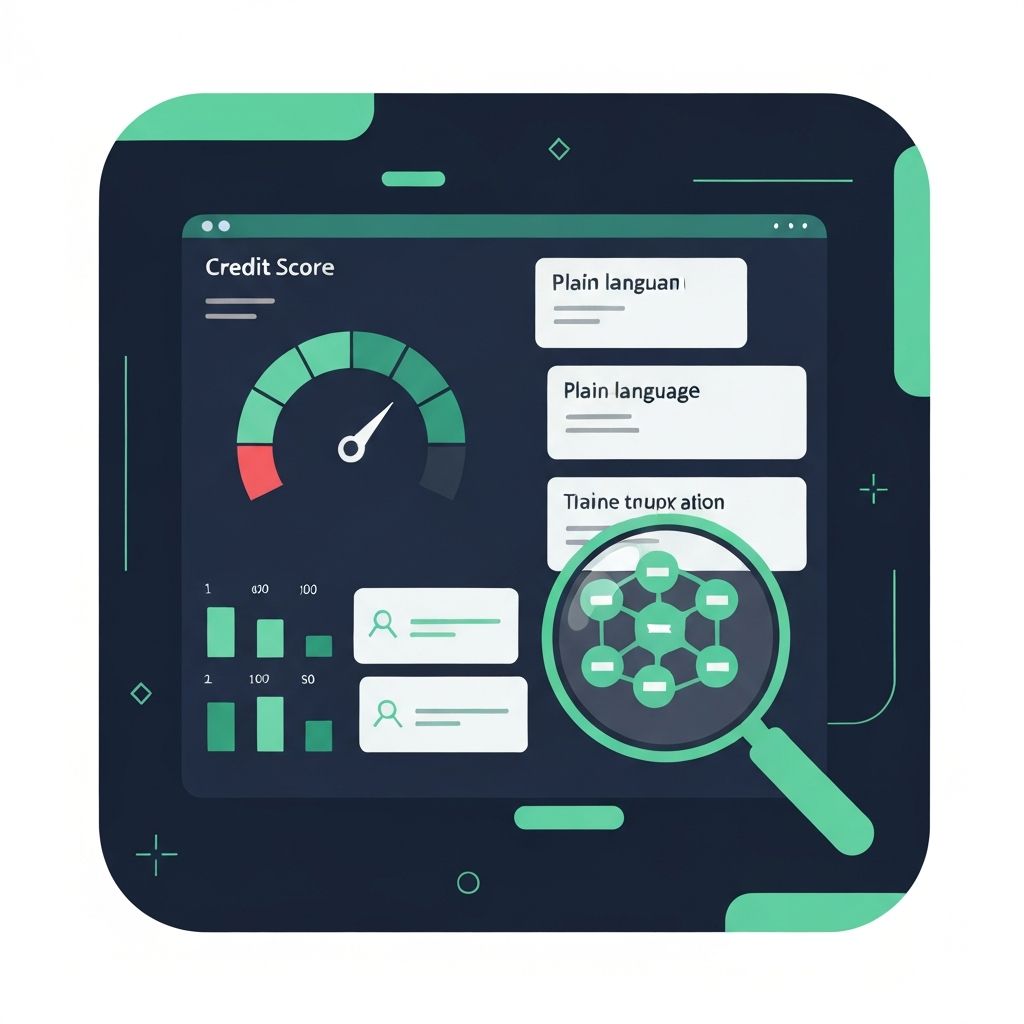
- Dashboard shows weighted factor contributions
- Each reason explained in plain English
- AI drafts personalized borrower communication
- Borrower gets a concrete improvement plan and returns
Why This Matters More Than Ever
ECOA Requires Specific Reasons
The Equal Credit Opportunity Act mandates that lenders provide a statement of specific reasons when taking adverse action. Even AI-driven models trigger this duty.
Borrowers Deserve Clarity
A confused borrower is a lost borrower. When you can explain exactly why a decision was made and what they can improve, you build trust and retain the relationship.
Regulators Are Watching
The CFPB has clarified that black-box models don't exempt lenders from adverse action notice requirements. Explainability isn't optional -- it's the law.
Competitive Advantage
LOs who can walk a borrower through a denial with clear, empathetic language convert more of those borrowers into future closings when their situation improves.
Key regulatory context: In 2022, the CFPB issued Circular 2022-03 clarifying that creditors using complex algorithms -- including AI and machine learning -- must still provide specific and accurate reasons for adverse actions. The circular states that simply citing the AI model's complexity is not an acceptable reason for failing to provide specific explanations.
Tools That Explain Credit Decisions in Plain Language
These tools range from enterprise AI underwriting platforms to everyday AI assistants. The right choice depends on whether you need institution-level explainability or personal productivity tools.
Zest AI
AI Underwriting Platform
Plugs into your LOS and uses thousands of data points to produce risk rankings 2-4x more accurate than legacy scorecards. Its explainability dashboard surfaces game-theory-backed reasons for every decision in plain language.
Key Strengths
Best for: Lenders wanting to approve more borrowers without raising loss risk, with built-in compliance-grade explainability.
Upstart
AI Lending Platform
Originated nearly 700,000 fully automated loans in 2024. Uses non-traditional variables (education, employment history) alongside credit data, and provides detailed reason codes for every decision.
Key Strengths
Best for: Loan officers at partner institutions who want AI-powered decisioning with borrower-friendly explanations.
Microsoft Copilot
AI Assistant
Integrates into your existing Microsoft 365 workflow. Summarize lengthy underwriting findings, translate denial letters into conversational language, and draft borrower communication -- all within Word, Outlook, or Teams.
Key Strengths
Best for: Individual LOs who need to quickly translate underwriting results into client-ready communication.
Google Gemini (formerly Duet AI)
AI Assistant
Google Workspace's AI layer. Paste underwriting findings into Docs or Sheets and ask Gemini to explain them in borrower-friendly terms, identify risk factors, or suggest improvement paths.
Key Strengths
Best for: Google Workspace users who want AI explainability without switching platforms.
5 Real-World Use Cases
Translating Adverse Action Notices
The Problem
An adverse action letter arrives packed with reason codes and regulatory language. Your borrower calls confused, frustrated, and ready to walk away.
The AI Solution
Paste the adverse action notice into Copilot or Gemini and ask: 'Translate this into a borrower-friendly email that explains each reason and suggests specific steps to improve.' In 30 seconds you have a compassionate, clear message ready to send.
Step-by-Step Workflow
Real-World Scenario: Lisa -- Denver, CO
A borrower was denied for a jumbo loan. The adverse action notice cited DTI ratio, insufficient reserves, and limited credit history depth. Lisa pasted the notice into Copilot and asked for a borrower-friendly explanation.
Result: Within minutes she emailed the borrower a clear breakdown: 'Your monthly debt payments are currently 48% of your income -- jumbo loans typically need 43% or below. Here are three steps to get there...' The borrower paid down a car loan over 4 months and closed with Lisa on a $780,000 purchase.
Understanding Credit Score Drivers
The Problem
A borrower asks 'Why is my score 640 and not 700?' and you're left pointing at generic factors like 'length of credit history' without real context.
The AI Solution
Platforms like Zest AI provide SHAP-value dashboards that show the exact weight each factor contributed to the score. You can show borrowers a visual breakdown: 'Your credit utilization is 72% -- that's pulling your score down by approximately 45 points. Getting it below 30% could push you into the 700s.'
Step-by-Step Workflow
Real-World Scenario: Marcus -- Atlanta, GA
A first-time buyer had a 635 score and was frustrated after being told to 'work on their credit' by a previous LO. Marcus used his Zest AI dashboard to show the borrower that two factors -- a $2,100 collections account and 78% credit utilization -- accounted for over 60% of the score gap.
Result: The borrower disputed the collections (it was a medical billing error), paid down one credit card, and rescored at 698 six weeks later. Marcus closed a $340,000 FHA-to-conventional conversion.
Pre-Submission Underwriting Review
The Problem
You submit a file to underwriting and get conditions back that you should have caught. Resubmissions slow down closings and frustrate borrowers.
The AI Solution
Before submission, use AI to scan the file and flag potential issues. Upload the 1003, credit report, and income docs into an AI assistant and ask: 'Review this loan package for likely underwriting conditions and suggest documentation I should include proactively.'
Step-by-Step Workflow
Real-World Scenario: Jennifer -- Phoenix, AZ
Jennifer routinely got 8-12 conditions back on initial submissions. She started running every file through Gemini with a checklist prompt before submitting. The AI caught common issues -- unexplained deposits, gap in employment documentation, VOE timing.
Result: Her average conditions dropped to 3-4 per file, and her average close time decreased by 6 days. Her borrower satisfaction scores increased 22%.
Coaching Borrowers Through Improvement Plans
The Problem
A borrower doesn't qualify today but could in 6-12 months. Without a concrete plan, they drift to another LO or give up on homeownership entirely.
The AI Solution
Use AI to generate a personalized credit improvement roadmap based on the specific factors that affected their decision. Include target dates, specific dollar amounts, and milestones with automated check-in reminders.
Step-by-Step Workflow
Real-World Scenario: David -- Tampa, FL
A borrower was denied conventional financing with a 608 score. David used Copilot to generate a customized 6-month plan: Month 1 -- dispute outdated collections; Month 2 -- request credit limit increases; Month 3 -- pay revolving balances below 30%; Months 4-6 -- maintain and season. He set automated monthly check-ins through his CRM.
Result: The borrower hit 672 in 5 months. David closed a $295,000 purchase and earned a referral to the borrower's sister, who closed 3 months later.
Fair Lending Audit Preparation
The Problem
Regulators ask why certain borrowers were denied and whether your AI-assisted decisions show disparate impact. Without documentation, you're scrambling.
The AI Solution
AI explainability platforms automatically log the reasons for every decision and can generate audit reports showing decision distributions across protected classes, with statistical analysis included.
Step-by-Step Workflow
Real-World Scenario: Regional Credit Union -- Midwest
A 12-branch credit union using Zest AI received a scheduled fair lending exam. The compliance team pulled Zest's explainability reports showing that their AI model approved 23% more minority borrowers than their previous scorecard while maintaining the same loss rate.
Result: The exam concluded in half the typical time. Regulators specifically cited the explainability documentation as a 'best practice example.' The credit union expanded its AI-assisted lending to auto and personal loans.
How AI Explains Itself: SHAP Values in Plain English
You don't need to be a data scientist, but understanding the basics of how AI explains its decisions helps you communicate with confidence. Most modern explainability tools use something called SHAP values (SHapley Additive exPlanations).
Think of it this way:
Imagine a basketball team wins by 15 points. SHAP values are like a box score that shows how many points each player contributed to the win (or how many they cost the team). Applied to credit: each factor in a borrower's profile gets a score showing how much it helped or hurt the final decision. High credit utilization might be -45 points, while a long payment history might be +30 points.
12-year payment history (positive)
72% credit utilization (negative)
Diverse account mix (positive)
When you can say to a borrower, "Your utilization is pulling your score down by roughly 45 points -- getting it below 30% could push you into the mid-700s," you're not guessing. You're armed with data-driven precision that builds trust and creates action.
Compliance Checklist for AI-Assisted Credit Decisions
Adverse Action Notices
Every denial must include specific, accurate reasons -- even when AI made the decision. Generic reasons like 'insufficient credit' are not acceptable.
Model Documentation
Maintain documentation of how your AI model works, what data it uses, and how it was validated for fairness. Regulators can request this at any time.
Fair Lending Testing
Regularly test AI decisions for disparate impact across protected classes. Many AI platforms include built-in fairness monitoring.
Consumer Dispute Rights
Borrowers have the right to request reconsideration. Your process must allow for human review of AI-assisted decisions.
By the Numbers
Loans automated by Upstart in 2024
More accurate risk rankings with AI vs. legacy scorecards
More minority borrowers approved with AI explainability
More likely to return when given a concrete improvement plan
Getting Started: Your First Week
Start with what you have
Take your last 3 adverse action notices and paste them into Copilot or Gemini. Prompt: 'Translate this into a borrower-friendly email that explains each reason simply and suggests specific steps to improve.' Save the outputs as templates.
Build your prompt library
Create saved prompts for your top 5 denial scenarios: DTI too high, insufficient reserves, short credit history, recent derogatory events, and employment gaps. Test each one with real (anonymized) data.
Explore platform-level tools
If your company uses an AI-enabled LOS, schedule a demo of the explainability dashboard. If not, research Zest AI or similar platforms and bring the information to your next team meeting.
Test with a real borrower
The next time you get a conditional approval or denial, use your new AI workflow to generate the explanation. Time how long it takes versus your old process and note the borrower's response.
Pro Tips from Top Producers
Lead with empathy, not data
When explaining a denial, start with 'I understand this isn't the news you wanted' before diving into the reasons. AI gives you the data -- but you provide the human touch that keeps the borrower in your pipeline.
Turn every denial into a future closing
Use AI to generate a specific improvement plan within 24 hours of a denial. Borrowers who receive a concrete roadmap are 4x more likely to return to the same LO when they qualify.
Screenshot the dashboard
When platforms like Zest AI show visual factor breakdowns, screenshot them and walk borrowers through the visual on a screen share. People understand charts faster than paragraphs.
Build a prompt library for common scenarios
Create saved prompts in Copilot or Gemini for your most common denial reasons: DTI too high, insufficient reserves, short credit history, recent derogatory. You'll go from denial notice to borrower email in under 2 minutes.
Combine with MLO Assistant prompts
Use MLOAssistant.com prompts to generate follow-up email templates for denied borrowers, then personalize them with the specific AI-generated explanations. The combination of template efficiency and data-driven personalization is powerful.
The Bottom Line
AI credit explainability isn't just about compliance -- it's about being the loan officer who can look a borrower in the eye and say, "Here's exactly what happened, here's why, and here's how we fix it." That clarity builds trust. Trust builds referrals. And referrals build careers.
The tools exist today. Whether you start with a simple AI assistant translating adverse action notices or push for enterprise-grade explainability dashboards, every step toward transparency makes you a better communicator, a more compliant originator, and a more successful loan officer.